
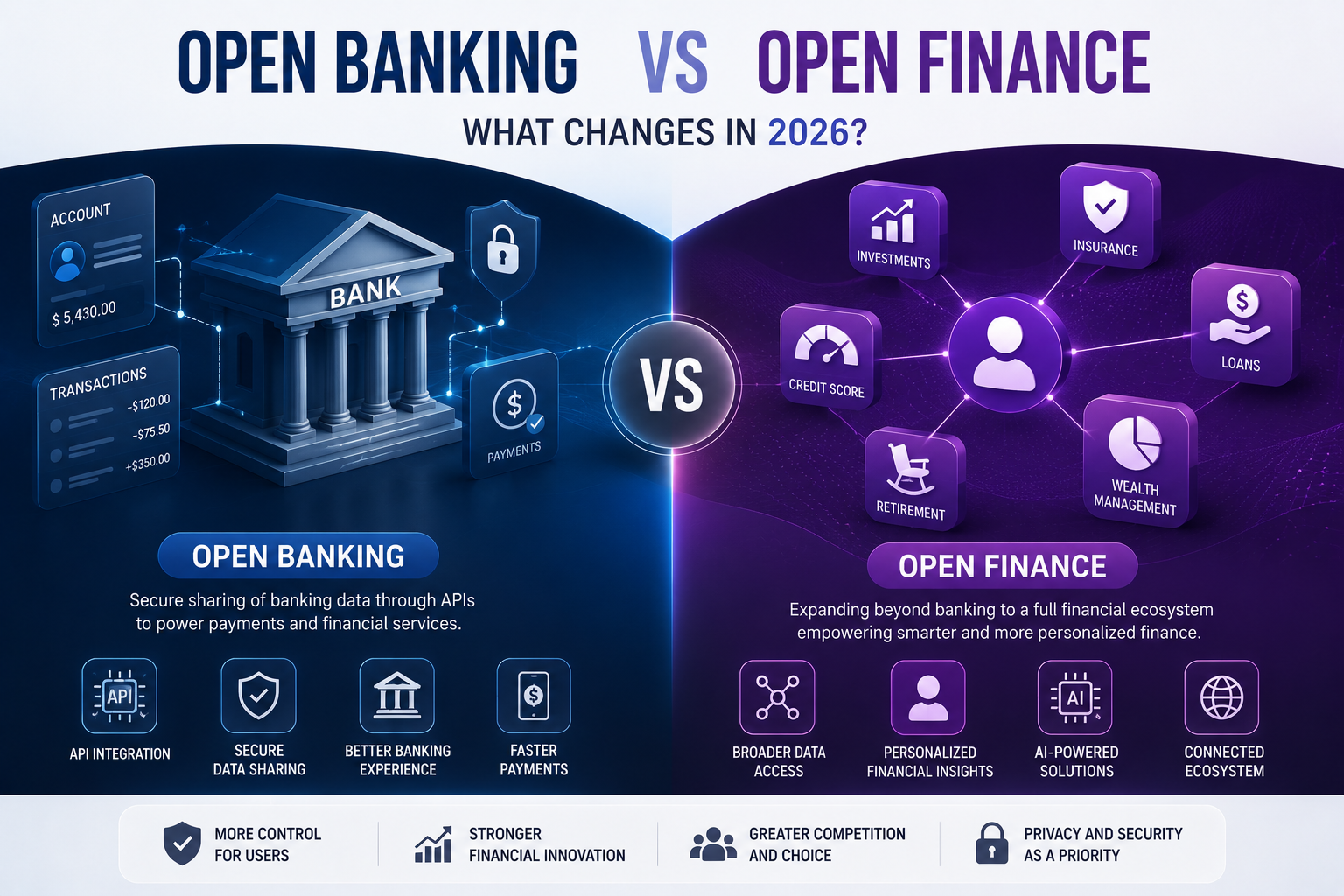
The financial technology industry continues evolving rapidly in 2026 as Open Banking and Open Finance become increasingly important across digital banking ecosystems, fintech platforms and online payment services.
While Open Banking initially transformed how banks share payment and account information through APIs, Open Finance is now expanding the concept into a much broader financial data ecosystem that includes investments, insurance, lending and wealth management services.
As governments, regulators and fintech companies continue pushing for greater financial connectivity and data portability, Open Finance is emerging as one of the biggest trends shaping the future of digital finance.
What Is Open Banking?
Open Banking refers to systems that allow banks and financial institutions to securely share customer banking data with approved third-party providers through APIs, also known as Application Programming Interfaces.
With user consent, Open Banking platforms can provide access to:
- Bank account information
- Transaction history
- Payment services
- Balance data
- Financial insights
The goal is to improve competition, innovation and customer control within the banking sector.
What Is Open Finance?
Open Finance expands beyond traditional banking data by including a wider range of financial products and services.
Open Finance ecosystems may include:
- Investment accounts
- Insurance products
- Pension systems
- Mortgage services
- Cryptocurrency platforms
- Wealth management tools
This broader model allows consumers to manage more aspects of their financial lives through interconnected digital platforms.
Open Banking vs Open Finance in 2026
| Feature | Open Banking | Open Finance |
|---|---|---|
| Main Focus | Bank account data | Full financial ecosystem |
| Services Included | Payments and banking | Investments, insurance, lending and more |
| Data Sharing Scope | Limited financial data | Expanded financial information |
| API Integration | Banking-focused APIs | Multi-service financial APIs |
| User Control | Banking permissions | Broader financial management |
| Industry Impact | Digital banking innovation | Complete fintech ecosystem transformation |
Why Open Finance Is Expanding in 2026
Several major trends are accelerating Open Finance adoption worldwide.
These include:
- Growth of fintech platforms
- AI-powered financial tools
- Demand for personalized banking
- Digital payment innovation
- Expansion of embedded finance
- Cross-platform financial management
Consumers increasingly expect unified digital experiences that combine multiple financial services in one ecosystem.
API Technology Continues Driving Innovation
APIs remain the foundation of both Open Banking and Open Finance systems.
Modern APIs allow financial institutions and fintech companies to securely exchange data in real time.
This technology helps support:
- Faster payment systems
- Automated financial management
- Real-time transaction monitoring
- Integrated fintech services
- Personalized banking experiences
As API infrastructure improves, financial ecosystems are becoming more interconnected and efficient.
Consumers Want More Financial Personalization
Personalized finance has become one of the most important trends in digital banking.
Open Finance platforms can use broader financial data to deliver:
- Customized investment suggestions
- Smarter budgeting tools
- AI-powered financial insights
- Personalized lending offers
- Automated savings strategies
This level of personalization is becoming increasingly important for fintech companies competing for customer engagement.
Embedded Finance Is Expanding Rapidly
Embedded finance is another major trend closely connected to Open Finance growth.
Companies outside traditional banking are increasingly integrating financial services directly into their platforms.
Examples include:
- Buy now, pay later systems
- Integrated insurance products
- In-app lending services
- Digital wallets
- Merchant payment systems
Open Finance infrastructure helps enable these integrations through secure financial data sharing.
Security and Data Privacy Remain Key Concerns
As financial data sharing expands, cybersecurity and privacy concerns continue growing.
Key issues include:
- Data protection standards
- User consent management
- Fraud prevention systems
- API security
- Financial identity protection
Regulators and fintech companies continue investing heavily in encryption, compliance and secure authentication technologies.
AI and Automation Are Influencing Financial Platforms
Artificial intelligence is increasingly integrated into Open Finance ecosystems.
AI-driven systems can help users:
- Analyze spending habits
- Track financial goals
- Detect unusual transactions
- Optimize investments
- Improve budgeting strategies
Many financial institutions now view AI-powered automation as essential for future digital banking services.
Regulators Continue Expanding Financial Frameworks
Governments and financial regulators worldwide continue updating policies surrounding financial data sharing.
Many regions are working on frameworks designed to:
- Increase consumer control
- Improve competition
- Encourage fintech innovation
- Strengthen cybersecurity
- Expand interoperability
Regulatory modernization is expected to remain one of the key drivers behind Open Finance adoption.
Traditional Banks Face More Competition
Open Finance is increasing competition between traditional banks and fintech companies.
Digital-first financial platforms often move faster when developing:
- Mobile banking tools
- Personal finance apps
- Investment platforms
- Payment innovations
- AI-driven financial services
This pressure is forcing traditional banks to accelerate digital transformation strategies.
The Future of Open Finance
Industry analysts expect Open Finance to continue expanding significantly over the next decade.
Future developments may include:
- Cross-border financial ecosystems
- AI-driven wealth management
- Unified financial dashboards
- Blockchain-integrated finance systems
- More advanced embedded finance platforms
The broader financial industry is gradually moving toward highly connected digital ecosystems centered around user-controlled data sharing.
Conclusion
Open Banking and Open Finance are reshaping the future of digital finance in 2026 through API-driven innovation, financial data sharing and personalized banking experiences.
While Open Banking focused primarily on banking services and payments, Open Finance is expanding connectivity across investments, insurance, lending and wealth management platforms.
As fintech competition intensifies and digital financial ecosystems continue evolving, Open Finance is expected to become one of the most influential trends within the global financial industry.
