
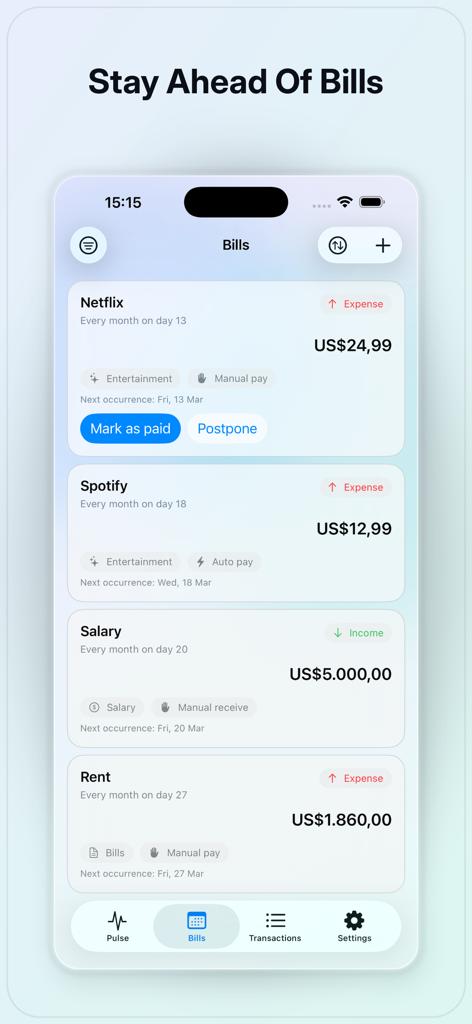
A monthly streaming subscription is easy to recognize when the same amount leaves an account on the same day every month. Real financial activity is rarely that tidy. An electricity bill changes with usage, an insurance payment may arrive annually, a mobile plan can include additional charges and some services shift their billing date when it falls on a weekend. For a banking app trying to identify recurring expenses automatically, these variations make a seemingly simple feature surprisingly complex.
Banks and financial apps are becoming better at detecting these patterns because users increasingly expect their accounts to explain what is likely to happen next, not simply display what already happened. Recurring payment detection turns transaction history into something more useful: an early view of regular financial commitments that can influence the balance available over the coming days and weeks.
Recurring does not always mean identical
The easiest recurring payment to detect has the same merchant, amount and billing interval every time. A $15 charge from the same service every 30 days leaves an obvious pattern, but many household expenses do not behave this way.
Utility bills can rise or fall considerably between seasons while still representing the same monthly commitment. Insurance premiums might be charged monthly, quarterly or annually, while loan payments can remain stable but appear under slightly different transaction descriptions. Even the same merchant can process payments through different entities or descriptors.
A useful detection system therefore needs to look beyond identical transaction amounts. Timing, merchant information, previous payment behavior and transaction descriptions can collectively indicate that several charges belong to the same recurring relationship. This is an important distinction because overly strict detection misses legitimate regular expenses, while overly broad detection can label ordinary repeat purchases as subscriptions or bills.
Upcoming payments make the current balance more meaningful
A bank balance shows how much money is available at that moment, but it says little about how much of that money is effectively committed. Someone might have $1,200 in an account while $700 of predictable expenses are due before the next payday. Without that context, the displayed balance can create a misleading impression of available spending power. Identifying recurring payments allows an app to provide a more realistic picture by showing which known expenses are approaching.
This does not require the bank to know the exact value of every future transaction. An estimated range or an expected payment based on previous activity can still help users understand what is likely to leave the account. The feature becomes especially useful when several small payments are distributed throughout the month. Individually they may appear insignificant, yet together they can have a noticeable effect on available cash.
Variable bills are the harder problem
Fixed subscriptions receive much of the attention in personal finance tools because they are easy to classify, but variable recurring bills can be more important to everyday budgeting. Electricity, gas, water and telecommunications charges often follow recognizable schedules while changing in value. An app that only recognizes identical amounts could fail to identify them as recurring, even though the user considers them predictable monthly obligations.
More advanced systems can examine a payment range rather than one exact figure. If a utility provider has charged the account approximately once every month for the past year, variations in the amount should not necessarily break the pattern. The same logic can apply to regular payments whose dates move slightly. A bill normally charged on the 15th might appear on the 14th or 16th depending on processing times and weekends. Effective recurring payment detection needs enough flexibility to recognize that the underlying pattern has not actually changed.
Merchant recognition improves the feature
Recurring payment detection becomes more useful when the app also understands who received the money. Raw transaction descriptions are often messy, abbreviated or filled with processing information that means little to an ordinary account holder.
Cleaning this information allows several payments to be grouped under a recognizable merchant instead of appearing as unrelated strings of text. Once that relationship is established, the app can present a clearer history showing how frequently the merchant charges the account and how the amount has changed over time.
This context can also prevent confusion when a user sees an upcoming payment prediction. Recognizing the service or company immediately is far more useful than receiving an alert containing an obscure payment processor code.
Not every repeated purchase is a recurring commitment
One of the most important challenges is distinguishing recurring payments from frequent shopping behavior. Someone who buys coffee from the same café every weekday is creating an obvious transaction pattern, but those purchases are not scheduled obligations. The difference is important because incorrectly labeling everyday merchants as recurring payments can quickly make the feature noisy. Users may stop paying attention if their predicted bills page becomes filled with supermarkets, restaurants and other places they simply visit regularly.
Frequency alone is therefore a weak signal. A useful system needs to consider intervals, payment characteristics and historical consistency before treating a merchant as an expected future charge. Giving users the ability to correct classifications can improve the experience further. A simple option to mark a transaction as recurring or remove an incorrect prediction allows the financial view to become more accurate over time.
Changes in regular payments can become useful signals
Once an app has identified a recurring expense, it can also detect when the pattern changes. This creates possibilities beyond simply predicting the next payment date. A monthly service that normally costs $20 but suddenly charges $27 represents useful information. The increase might be expected, perhaps because the user changed plans, but it could also indicate a price rise that went unnoticed.
Similarly, a regular payment disappearing for several months can be meaningful. The service may have been cancelled, the payment method may have changed or the merchant might no longer be active. Presenting these changes carefully can make transaction data more informative without overwhelming users with alerts. The goal is not to flag every minor variation, but to highlight differences large enough to deserve attention.
Recurring payment detection can support cash-flow planning
The biggest value of the feature appears when recurring payments are combined with income and balance information. A list of upcoming bills is useful on its own, but it becomes considerably more powerful when placed on a financial timeline.
If an app knows that salary normally arrives near the end of the month and several regular payments occur beforehand, it can show the period where the account balance may become tight. This gives users an opportunity to adjust discretionary spending or move money before a payment arrives.
Importantly, such projections should remain clearly identified as estimates. Transaction timing can change, income can arrive late and variable bills cannot always be predicted precisely. A forecast is most useful when it communicates uncertainty rather than presenting an estimate as a guaranteed future balance.
Users need control over detected payments
Automation works best when users can see and correct what the system has decided. A banking app might accurately detect most recurring payments but still misunderstand an unusual purchase or fail to recognize a new bill.
Allowing users to confirm, edit or remove recurring classifications makes the feature easier to trust. They might also want to rename a payment, adjust its expected frequency or exclude it from future cash-flow estimates.
These controls do not need to be complicated. In many cases, a few simple actions are enough to turn automated detection into a collaborative feature where the software handles most of the work while the account holder corrects exceptions.
A transaction list is gradually becoming a financial calendar
Digital banking originally focused on showing balances and completed transactions. Recurring payment detection pushes the interface toward a different model where past activity helps explain the near future. Instead of opening an app and seeing only what has already been spent, users can see that rent is approaching, a utility payment is expected next week and several smaller recurring charges are likely before the next income payment. That information makes the same account balance much easier to interpret.
The feature may look modest compared with larger developments in digital banking, but its value comes from solving a routine problem. People already know that regular expenses exist; what they often lack is a single, continuously updated view of when those expenses are likely to arrive and how much money they may consume. Better recurring payment detection is gradually giving banking apps that role.
