
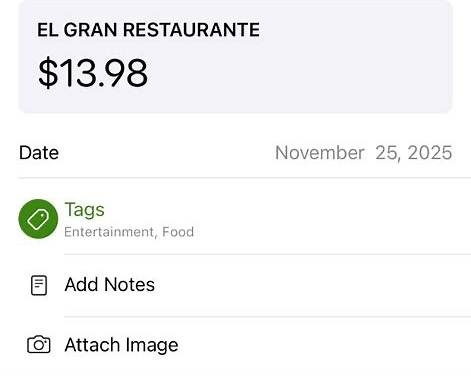
A transaction history can tell someone where money went, how much was spent and when the payment occurred. What it often cannot explain is why the purchase mattered.
A €68 card payment from six months ago may have been a business lunch, a replacement part for a bicycle or a shared expense that someone promised to repay. The merchant name and transaction category provide useful clues, but they do not preserve the personal context surrounding the payment. This is why transaction notes and attachments are becoming a useful addition to digital banking.
Transaction Data Does Not Capture the Whole Purchase
Banks receive structured information about payments, but customers experience purchases in a much richer context. Two transactions from the same merchant for exactly the same amount can have completely different purposes. Automatic categorization can identify a restaurant payment as dining or a hardware-store purchase as home improvement. That still does not explain whether the expense was personal, shared with another person or connected to a particular project.
A simple note can fill that gap. Instead of relying on memory months later, the customer might add “Dinner with client,” “Birthday present for Anna” or “Replacement kitchen tap” directly to the transaction. The bank does not need to infer this information. The user already knows it at the moment of purchase.
Receipts Can Give Transactions a Second Layer of Detail
Paper and email receipts contain information that usually does not appear in a bank transaction. A supermarket payment might contain twenty individual products. A hotel transaction may relate to a specific booking. A hardware-store purchase could include several items with different warranties.
Allowing users to attach a receipt or invoice creates a connection between the financial record and the document explaining what was actually purchased.
| Banking record | Additional information a user could save |
|---|---|
| Restaurant payment | Who attended or why the meal mattered |
| Electronics purchase | Receipt and warranty information |
| Shared purchase | Names of people splitting the cost |
| Business expense | Invoice or project reference |
| Travel purchase | Booking or reservation details |
| Home repair | Contractor invoice and description |
The transaction remains the financial record. The attachment simply makes that record easier to understand later.
Notes Become More Valuable With Time
Immediately after making a purchase, remembering its purpose is easy. Several months later, the same transaction can become surprisingly difficult to identify. This is particularly common with merchants whose statement names differ from their customer-facing brands. Even when the merchant is recognizable, the transaction itself may not reveal what was purchased.
A note added at the time of payment preserves information while it is still obvious. That can be useful during annual budgeting, expense reviews or simply when trying to remember why an unusually large payment occurred. The feature is small, but its value grows as transaction history becomes older.
Search Can Make Personal Notes Much More Useful
Notes become considerably more powerful when they are searchable. Suppose a user bought several items while renovating an apartment and added the word “renovation” to each relevant transaction. Months later, searching for that term could bring those payments together even if they were made at completely different merchants.
The same approach could work for a wedding, holiday, work trip or any other temporary project. This creates a lightweight organizational layer without requiring the banking app to invent another permanent spending category. Categories answer broad questions such as how much was spent on transport or dining. User-created notes can answer much more specific questions that only matter to that individual.
Shared Expenses Are Easier to Remember With Context
Shared purchases create another common memory problem. Someone pays €120 for dinner and receives money from friends later. The original card payment and incoming transfers may appear separately in the account history, leaving the user to remember how they relate.
A note could record who participated or how the cost was divided. More advanced banking apps could eventually connect the original transaction with repayments, but even a basic text field can preserve enough context to make the activity understandable later.
This is particularly useful because shared expenses do not always fit neatly into financial categories. The important information is often not what was purchased, but who ultimately paid for it.
Attachments Could Help With Warranties and Returns
Receipts often become important long after the payment itself. A product fails after several months and the customer needs proof of purchase. A return requires the original receipt. An appliance warranty depends on the purchase date. Finding that document can be much harder than finding the transaction.
If a banking app allows a receipt to be attached directly to the corresponding payment, the transaction itself becomes an index for retrieving the document. This does not mean a banking app needs to become a full document-management system. The useful connection is much simpler: the user finds the payment and the supporting document is available beside it.
Business and Personal Banking Could Use the Feature Differently
Transaction notes have obvious applications for freelancers and small businesses. A self-employed user may want to record which client or project relates to an expense. An invoice could be attached to an incoming payment, while a receipt could accompany a business purchase.
Personal users may care more about warranties, shared expenses, gifts or major household purchases. The underlying feature is the same, but the reason for using it changes. This flexibility is one of its strengths. Unlike an automated financial insight designed for a particular behavior, a free-text note does not need the bank to predict what information matters.
Privacy Becomes Important When Users Add Their Own Information
Allowing customers to store additional context also creates a responsibility for the app. A normal transaction record already contains sensitive financial information. Personal notes could add names, project details or other information that was never part of the original payment data. Attachments can contain even more. Receipts may show addresses, loyalty identifiers or detailed purchase information. Invoices can contain personal or business details.
Banking apps therefore need to treat notes and uploaded documents as part of the sensitive account environment. Users should understand where attachments are stored, whether they synchronize across devices and what happens to them if the underlying transaction or account is no longer available. Convenience should not make those questions invisible.
Automation Should Assist Rather Than Rewrite Personal Context
There is an obvious opportunity to apply AI or document recognition to attached receipts. An app could identify the purchase date, merchant, total amount or individual items and connect them with the transaction automatically. It might also suggest a short description based on the document.
That could reduce manual work, but personal notes serve a different purpose from automatic transaction enrichment. A system can recognize that €95 was spent at a restaurant. It cannot necessarily know that the dinner was held to celebrate a promotion or that three friends still need to repay their shares. The most useful design may therefore combine both approaches. Software handles information it can reliably extract, while the user retains control over the context only they understand.
Transaction History Can Become a Personal Financial Archive
Banking apps have already moved far beyond digital versions of monthly statements. They categorize purchases, recognize merchants, track payment states and increasingly explain what is happening around a transaction. Notes and attachments add something different. Instead of asking the bank to interpret more information automatically, they give customers a place to preserve their own information alongside the financial record.
A transaction can then become more than a merchant, date and amount. It can carry the receipt proving what was purchased, a note explaining why it mattered or a reference connecting it with a larger project. For users who rarely need that additional context, the feature can remain almost invisible. For the transactions that do matter months or years later, however, a small note or attached receipt can make the difference between a mysterious line in account history and a record that still makes sense.
