
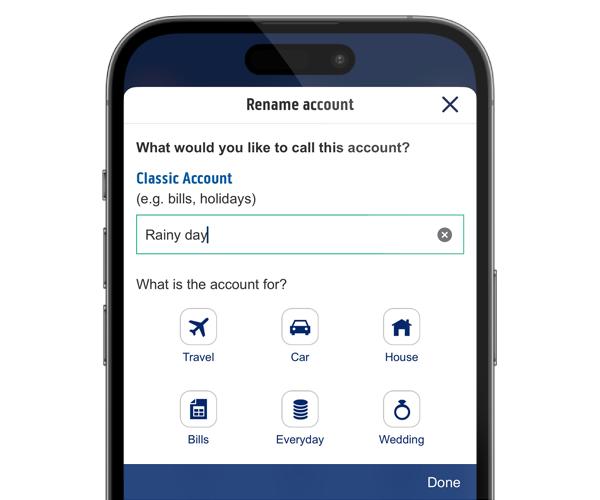
A banking app may show several accounts that look almost identical. One is used for everyday spending, another holds emergency savings, a third contains money for an upcoming trip and another is reserved for household bills. Technically, each account can already be identified by its number, type or balance, but those details do not necessarily explain what the money is actually for.
Allowing customers to rename accounts solves this small but persistent usability problem. Instead of remembering that a particular savings account ending in 4821 is the holiday fund, a user can simply call it “Summer Trip.” The feature requires very little space or technical complexity from the customer’s perspective, yet it can make a growing collection of accounts considerably easier to understand.
Account Numbers Identify Accounts but Not Their Purpose
Banks need formal identifiers because accounts must remain distinguishable inside financial systems. Customers usually think about their money differently. They are more likely to remember a purpose such as rent, taxes or emergency savings than the final four digits of an account number.
This difference becomes more noticeable as people open additional accounts. A customer with one current account and one savings account may have little difficulty distinguishing between them. Someone managing several savings pots, joint accounts or accounts in different currencies has more information to remember.
Custom names provide a human-readable layer on top of the formal banking structure. The underlying account number does not change, and the bank can continue using its official identifiers where necessary. The nickname simply helps the customer understand what each balance represents.
Names Can Turn Balances Into Clearer Financial Categories
A balance of €2,500 does not explain why the money is there. Label the same account “Emergency Fund,” and the balance immediately gains context. This is one reason custom names can influence how users interpret their banking home screen. Instead of seeing a collection of numbers, they see money connected to particular purposes. An account called “Monthly Bills” communicates something different from one called “New Car,” even if both contain exactly the same amount.
The distinction can also reduce the need for separate notes or spreadsheets. Users do not have to remember which account corresponds with each goal because that information is visible whenever they open the banking app.
| Generic account label | Custom name | Immediate meaning |
|---|---|---|
| Savings Account 1 | Emergency Fund | Money reserved for unexpected costs |
| Savings Account 2 | Summer Trip | Travel savings |
| Current Account 2 | Household Bills | Regular shared expenses |
| Savings Account 3 | House Deposit | Long-term property goal |
| Current Account 3 | Freelance Tax | Money reserved for tax payments |
The feature does not create a financial plan by itself, but it can make an existing plan easier to see.
Custom Names Become More Useful as Banking Gets More Complex
Digital banking has made it easier to create additional accounts, sub-accounts and savings spaces. That flexibility is useful, but it also creates a navigation problem. The more separate balances a customer manages, the less effective generic labels become.
Two accounts called “Easy Access Savings” may have different purposes even if they are technically the same product. Their official product names therefore tell the customer very little about how they are being used.
Custom naming allows the interface to adapt to the customer’s own financial structure without requiring the bank to create a different product for every possible purpose. One person might use an account for annual insurance payments, while another uses the same account type for Christmas spending. The underlying banking product remains identical while the interface reflects two very different uses.
This makes personalization practical rather than decorative. The app is not merely changing colors or rearranging widgets; it is displaying the customer’s money using language that makes sense to that individual.
Account Nicknames Can Make Transfers Less Confusing
The value of account names becomes especially clear when moving money between a user’s own accounts. A transfer screen containing several similar account numbers forces the customer to stop and verify which destination is correct.
Names such as “Main Spending,” “Tax,” “Emergency” and “Travel” make those choices easier to distinguish. The user can still inspect formal account details when necessary, but routine internal transfers require less interpretation.
This is particularly useful when money moves regularly between accounts. Someone might transfer part of each salary payment into savings and another amount into a bills account. Recognizable names can make that routine easier to follow because the destination reflects the reason for the transfer.
Good interface design should still prevent ambiguity. A nickname should complement important account information rather than completely hide it. Displaying a custom name alongside an abbreviated account number can provide both familiarity and confirmation.
Naming an Account Can Reinforce the Purpose of the Money
There is also a behavioral difference between seeing “Savings 2” and seeing “Emergency Fund.” The second label reminds the user why the money was separated in the first place.
That reminder can matter when someone is considering moving money back into a spending account. With a generic label, the balance may simply look available. A purpose-specific name makes the original intention more visible at the moment a decision is being made.
The effect should not be exaggerated. Renaming an account cannot prevent unnecessary spending, create savings automatically or replace financial planning. It can, however, add useful context to a balance that would otherwise be represented only by a number.
The same principle already appears in physical money management. People have long separated cash into envelopes labelled for rent, groceries or other expenses. Custom account names bring a small part of that organizational logic into digital banking without requiring physical separation.
Joint Accounts Benefit From Shared Terminology
Account naming can become even more useful when finances are managed by more than one person. A couple or household may have separate balances for utilities, groceries, holidays and other shared costs.
Clear labels give everyone a common way to refer to those accounts. “Transfer it to Household Bills” is easier to understand than referring to a product name or account suffix, particularly when several similar accounts exist.
Banks need to decide carefully how custom names behave in shared products. If one account holder changes a nickname, the platform should make it clear whether the new name appears for everyone or only for that individual. Different approaches can work, but the behavior should be predictable.
This illustrates a broader point about apparently simple personalization features. A text label may look trivial on the screen, yet it interacts with permissions, shared access and the underlying account structure.
Good Naming Features Need a Few Sensible Limits
Giving users control over account labels does not mean the field needs to accept unlimited text. Short names usually work better because they remain readable on home screens, transfer menus and smaller mobile displays.
Apps may also need to distinguish clearly between a nickname and the official account or product name. A customer should not accidentally assume that changing “Everyday Account” to “Business Expenses” has changed the legal type or terms of the account.
The strongest interfaces therefore preserve access to formal information while prioritizing the custom label during everyday navigation. A user might see “Holiday Fund” prominently with “Savings • 4821” underneath it. That arrangement provides both kinds of information at once: the personal meaning of the account and the formal details needed to identify it accurately.
Custom Names Fit a Broader Shift Toward User-Organized Banking
Early digital banking largely reproduced information from statements. Accounts had official names, transactions had formal descriptions and customers were expected to interpret the structure provided by the bank.
Modern banking interfaces increasingly allow users to organize that information themselves. They may categorize transactions, create savings goals, control cards and decide which information appears most prominently. Account naming belongs to the same broader shift, but it addresses a particularly basic question: what is this money for?
The feature is valuable precisely because it does not try to make that decision automatically. A bank may be able to identify spending patterns or suggest financial actions, but only the customer necessarily knows why a particular account exists. Allowing a simple custom label gives that knowledge a place in the interface.
Small Labels Can Make a Large Account List Easier to Understand
Custom account names are unlikely to be the feature that persuades someone to choose one bank over another. They are more likely to become one of those small conveniences that customers notice when it is missing.
As digital banking gives people more ways to divide and organize money, generic account labels become less informative. Personal names can restore context by connecting each balance to the purpose the customer already has in mind.
The underlying financial product does not need to change. The account number stays the same, the balance stays the same and the bank’s records remain intact. What changes is the way the user understands the information on the screen.
Sometimes improving a banking interface does not require another prediction engine or complex dashboard. It can be as simple as letting people call an account what they already call it in their own head.
