
Sending money from a banking app can feel almost instantaneous. Enter the recipient’s details, choose an amount, confirm the transfer and the payment may leave within seconds. That speed is convenient, but it creates a simple problem: an account number can be technically valid without belonging to the person or company the sender intended to pay.
Banks and fintech platforms are increasingly trying to close that gap before money moves. Instead of checking only whether an account exists or whether its number has the correct format, newer verification systems can compare the recipient name entered by the customer with information held by the receiving bank. If the details do not correspond, the sender gets an opportunity to investigate before confirming the transfer.
A recent development shows how quickly this layer of payment infrastructure is expanding. In September 2026, identity and compliance provider Shufti launched Bank Account Verification across more than 70 countries, combining checks for account existence, ownership and IBAN validity within one system.
A Valid Account Number Is Not Enough
Traditional payment forms are good at checking structure. An app can identify whether an IBAN contains the correct number of characters, whether its checksum works or whether required fields have been completed. Those checks are useful because they can catch obvious typing errors. They do not necessarily answer the most important question: who actually owns the account?
Imagine that a customer receives an invoice from a contractor. The name on the invoice says Greenfield Renovations, but the account details have been altered and actually lead to another account. The account itself may be perfectly valid, so basic validation would find nothing wrong.
Account ownership verification introduces another checkpoint. The system can compare the intended recipient with information available from the bank before allowing the payment journey to continue.
| Check | What it can confirm | What it may not confirm |
|---|---|---|
| Account format | Details follow required structure | Who owns the account |
| IBAN checksum | IBAN is structurally valid | Recipient identity |
| Account existence | Account is active | Whether the intended person owns it |
| Name matching | Recipient name corresponds with bank data | Purpose of the payment |
| Identity verification | Customer identity | Ownership of every linked account |
The distinction is small from the user’s perspective but important for payment security.
Recipient Verification Happens Before the Money Moves
The best moment to identify incorrect payment details is before a transfer is sent. Once money reaches the wrong account, recovering it can become significantly more complicated. The sending bank may need to contact another financial institution, the recipient may need to cooperate and the result can depend on the payment rail and circumstances. Modern verification systems move part of that work earlier in the process.
When a user adds a recipient, the banking platform can send the supplied account information for verification. Depending on the country and available infrastructure, the response may include an account-holder name, a partial name or simply a match/no-match result.
Shufti’s recently launched system, for example, supports several response types including full-name return, masked-name return, match status, account existence checks and IBAN validation. The exact information available varies by market because banking and privacy frameworks differ between countries. For the user, however, the experience can remain simple: enter the recipient and find out whether the details appear consistent before sending money.
Why Name Matching Matters
Many payment mistakes are not sophisticated cyberattacks. Sometimes a digit is copied incorrectly, an old bank account is used or details intended for another recipient are pasted into the form. Name matching adds context that an account number alone cannot provide. Suppose someone intends to pay Daniel Morgan but enters details associated with D. Morrison. A system capable of comparing names can flag that discrepancy even if the account number itself is completely legitimate.
The result does not always need to be binary. Banking systems can potentially distinguish between different levels of confidence. A small variation such as “Robert Smith Ltd” and “Robert Smith Limited” may be treated differently from two completely unrelated names. That reduces the risk of stopping legitimate transfers simply because the wording is not character-for-character identical.
Businesses Need the Same Protection
Recipient verification is not useful only for person-to-person transfers. Businesses regularly send salaries, supplier payments, refunds and withdrawals. A wrong account entered into one of those workflows can redirect much larger sums than a typical personal transfer.
Consider a company changing the bank details used for a supplier. The supplier may genuinely have opened a new account, but a fraudulent email could also be attempting to replace legitimate payment instructions.
An ownership check creates another piece of evidence. The company can ask whether the new account corresponds with the expected recipient before adding it to future payment runs. This becomes particularly valuable when account details change rather than when they are first created.
Verification Can Continue After Onboarding
Banks already perform identity checks when customers open accounts, but that does not permanently eliminate risk. An account can be legitimate when opened and later compromised. A customer can also change the bank account used for payouts or withdrawals after the original onboarding process has finished.
That is why newer systems are moving verification closer to the moment of risk. Shufti says its platform can run checks when an account is added or changed and can require biometric re-authentication when payout or withdrawal information is edited. This represents a broader change in fintech security. Instead of treating verification as something completed once during registration, financial platforms can repeat specific checks when sensitive actions occur.
What the User Might See in a Banking App
Most customers do not need to understand the infrastructure behind account verification. The interface needs to translate the result into a clear action.
A typical payment journey might look like this:
- Enter the recipient’s name and account details.
- The banking app checks the account.
- The recipient information is compared with available bank records.
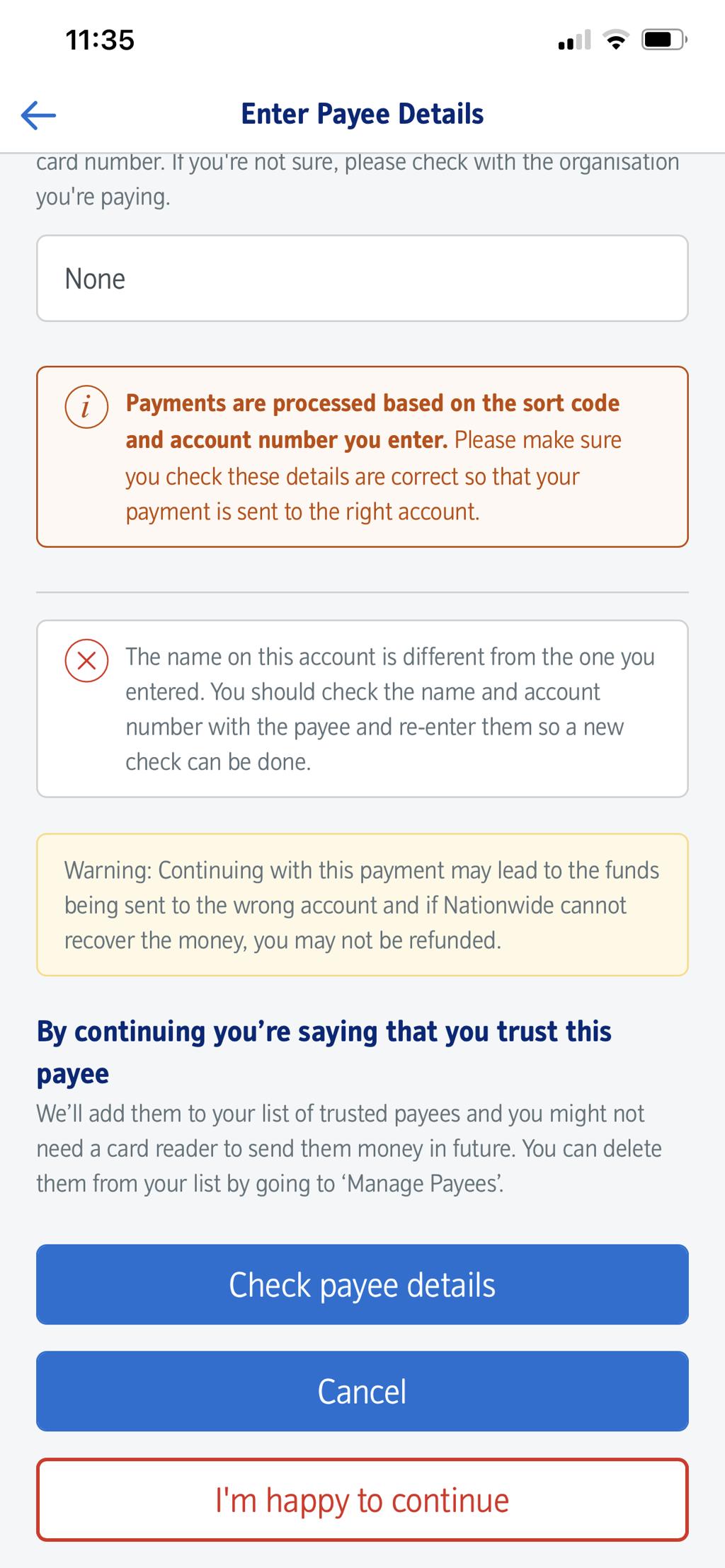
- The app displays a match, partial match or mismatch.
- The customer reviews the result before confirming the payment.
The wording matters. A vague error message such as “Something went wrong” gives the sender little information. A message explaining that the recipient name does not match the account details provides a reason to stop and check. At the same time, apps need to avoid making every minor spelling difference look like fraud. Good recipient verification should add useful friction only when something genuinely deserves attention.
Different Countries Return Different Information
One challenge is that bank account verification is not globally standardized. Some banking systems can return the account holder’s full name. Others restrict how much personal information can be shared and provide only a match result. In some markets, live bank verification may not yet be available at all.
Shufti’s 2026 implementation illustrates this variation. Its system can return a full account-holder name in some countries, while in Australia the bank performs the comparison and returns only whether the details match. Where live checks are unavailable, the platform may instead validate IBAN structure and checksum information. That means a banking app operating internationally cannot necessarily present identical verification results everywhere.
| Verification result | Possible app response |
|---|---|
| Full match | Continue with transfer |
| Partial match | Ask user to review recipient |
| No match | Warn before proceeding |
| Account inactive | Stop or request new details |
| Invalid IBAN | Ask user to correct information |
| Verification unavailable | Use normal payment checks |
The underlying capability may differ, but the goal remains consistent: identify questionable details while the sender still has time to correct them.
Regulation Is Pushing Verification Forward
Payment regulation is also encouraging more checks around account ownership. In Europe, Verification of Payee requirements are increasing the importance of comparing a payment recipient’s name with the account information held by the receiving institution. Other markets have their own requirements around validating accounts used for electronic payments.
In the United States, Nacha has required originators of certain internet-initiated ACH debits to validate that an account is open and valid before first use and after account-number changes since 2021. Shufti cites these differing requirements as one reason its new verification service adapts the response according to the market. The result is that account verification is moving from a specialist fraud-control feature toward a more normal part of payment infrastructure.
Better Verification Should Not Mean More Complicated Banking
There is always a trade-off between security and friction. If every transfer requires several additional forms, passwords and confirmation screens, customers may become frustrated or start ignoring warnings. If payments are too frictionless, however, mistakes and manipulated account details can travel through the system quickly.
Recipient verification offers an interesting middle ground because much of the work can happen behind the interface. The user enters information they would normally provide anyway. The system performs an additional check and intervenes only when the result deserves attention. That is different from simply adding another confirmation button.
Banking Apps Are Becoming More Context-Aware
Modern banking apps increasingly try to understand the context surrounding an action rather than simply execute instructions. A transfer is no longer only “send £500 to this account.” The platform can ask whether the account exists, whether the recipient information matches, whether the transaction looks unusual and whether sensitive account details were recently changed.
Account ownership verification adds another signal to that decision. It will not prevent every scam, and a successful name match does not prove that every payment is legitimate. A fraudster could still persuade someone to send money to an account whose name is correctly displayed. What it can do is remove one important area of uncertainty: whether the payment details correspond with the expected recipient.
As instant payments and mobile transfers become faster, that confirmation becomes more valuable rather than less. The shorter the time between entering details and moving money, the more useful it is to identify an inconsistency before the customer presses the final button. For banking apps, the next step in payment UX may therefore be less about making transfers even faster and more about making those few seconds before a transfer considerably smarter.
