
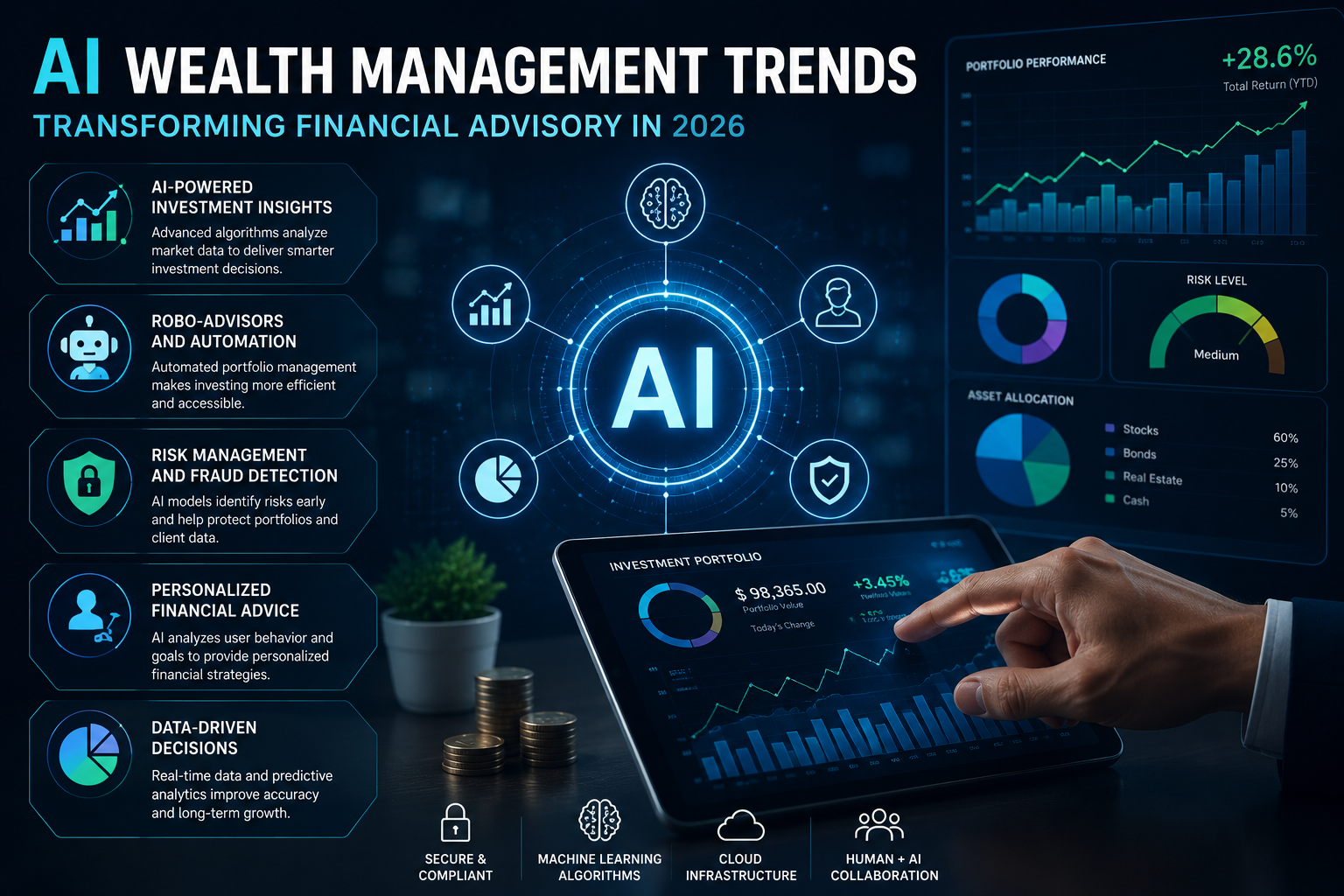
Artificial intelligence is rapidly transforming the global wealth management industry as financial advisors, fintech firms and investment platforms increasingly rely on automation, predictive analytics and AI-powered personalization to improve client services.
In 2026, AI wealth management trends are reshaping how investors manage portfolios, receive financial advice and interact with digital financial platforms. From robo-advisors and automated portfolio analysis to real-time market forecasting and AI financial assistants, technology is becoming deeply integrated into modern investment management.
As competition intensifies across fintech and digital banking sectors, wealth management firms are investing heavily in artificial intelligence to improve efficiency, reduce operational costs and deliver more personalized client experiences.
Why AI Is Changing Wealth Management
The financial advisory industry is undergoing major digital transformation as investors increasingly expect faster, smarter and more personalized financial services.
Artificial intelligence helps wealth management firms:
- Analyze financial data faster
- Automate portfolio management
- Improve investment recommendations
- Reduce operational workload
- Personalize financial strategies
- Detect market risks more efficiently
AI systems can process enormous volumes of market data in real time, allowing advisors and digital platforms to respond more quickly to changing financial conditions.
Robo-Advisors Continue Expanding
Robo-advisors remain one of the most visible examples of AI-driven wealth management.
These digital investment platforms use algorithms and automation to help users:
- Build investment portfolios
- Manage asset allocation
- Track financial goals
- Automate rebalancing
- Reduce investment fees
In 2026, many robo-advisors are becoming increasingly sophisticated through machine learning and predictive analytics integration.
Top AI Wealth Management Trends in 2026
| AI Trend | Main Impact |
|---|---|
| Robo-advisors | Automated investment management |
| Predictive analytics | Improved market forecasting |
| AI financial assistants | Personalized financial support |
| Automated portfolio rebalancing | Faster investment adjustments |
| Risk management AI | Real-time threat analysis |
| Client personalization systems | Customized advisory experiences |
AI Personalization Is Becoming a Competitive Advantage
Modern investors increasingly expect personalized financial guidance instead of generic investment recommendations.
AI wealth management platforms can now analyze:
- Risk tolerance
- Investment behavior
- Spending patterns
- Long-term financial goals
- Market preferences
This allows financial advisors and fintech companies to deliver highly customized portfolio strategies tailored to individual users.
Predictive Analytics Are Improving Investment Decisions
Predictive analytics technology is becoming increasingly important in modern portfolio management.
AI systems can analyze:
- Historical market trends
- Economic indicators
- Behavioral investment patterns
- Volatility risks
- Global financial events
While AI cannot guarantee investment performance, many firms believe predictive models help improve long-term financial decision-making.
AI Financial Assistants Are Expanding Across Fintech Platforms
Digital financial assistants are becoming more common across banking and investment applications.
Modern AI assistants can help users:
- Monitor portfolios
- Track spending habits
- Receive investment alerts
- Manage savings goals
- Access market updates
These systems are designed to improve engagement and simplify financial management for everyday investors.
Automated Portfolio Rebalancing Is Becoming Standard
Portfolio rebalancing is another area increasingly handled through artificial intelligence.
AI-driven investment systems can automatically adjust portfolio allocations based on:
- Market movements
- Risk exposure
- Asset performance
- Investment targets
This automation helps reduce manual oversight while improving efficiency for wealth management firms.
Fintech Companies Continue Investing in WealthTech
The rapid growth of WealthTech platforms is attracting major investment across the fintech industry.
Financial technology firms are increasingly competing through:
- AI-driven analytics
- Personalized investment tools
- Digital advisory systems
- Low-cost automated investing
- Mobile-first financial experiences
This competition is accelerating innovation throughout the digital wealth management sector.
Cybersecurity and Data Privacy Remain Major Concerns
As AI wealth management systems become more advanced, cybersecurity and financial data protection are becoming increasingly important.
Modern financial platforms must protect:
- Investment account data
- Personal financial information
- Transaction history
- Behavioral analytics
- Portfolio management systems
Financial institutions are investing heavily in encryption, fraud detection and digital identity protection technologies.
Human Advisors Still Play an Important Role
Despite the growth of automation, many experts believe human financial advisors will continue playing a major role in wealth management.
AI systems are highly effective for:
- Data analysis
- Automation
- Pattern recognition
- Operational efficiency
However, many investors still value human expertise for:
- Complex financial planning
- Emotional decision-making
- Retirement strategies
- Estate planning
- Personal relationships
The future of financial advisory may increasingly combine AI efficiency with human guidance.
AI Regulation and Ethical Concerns Continue Growing
Financial regulators worldwide are paying closer attention to how artificial intelligence is used inside investment and banking systems.
Key concerns include:
- Algorithm transparency
- Data privacy
- AI bias
- Automated financial decisions
- Regulatory compliance
As AI becomes more deeply integrated into finance, oversight and governance will likely continue expanding.
The Future of AI Wealth Management
Industry analysts expect artificial intelligence to become even more influential across financial advisory and investment management over the next decade.
Future trends may include:
- Fully autonomous investment systems
- Advanced AI market forecasting
- Voice-based financial assistants
- Real-time global portfolio optimization
- Hyper-personalized investment ecosystems
The combination of AI, fintech and digital banking infrastructure is expected to continue transforming modern financial services.
Conclusion
AI wealth management trends are rapidly reshaping the financial advisory industry in 2026 as automation, predictive analytics and personalized digital investing continue expanding.
From robo-advisors and AI financial assistants to automated portfolio management and advanced market analysis, artificial intelligence is becoming central to the future of investment services.
As fintech competition continues intensifying, wealth management firms that successfully combine AI innovation with strong client experiences will likely gain major advantages in the evolving digital finance landscape.
