
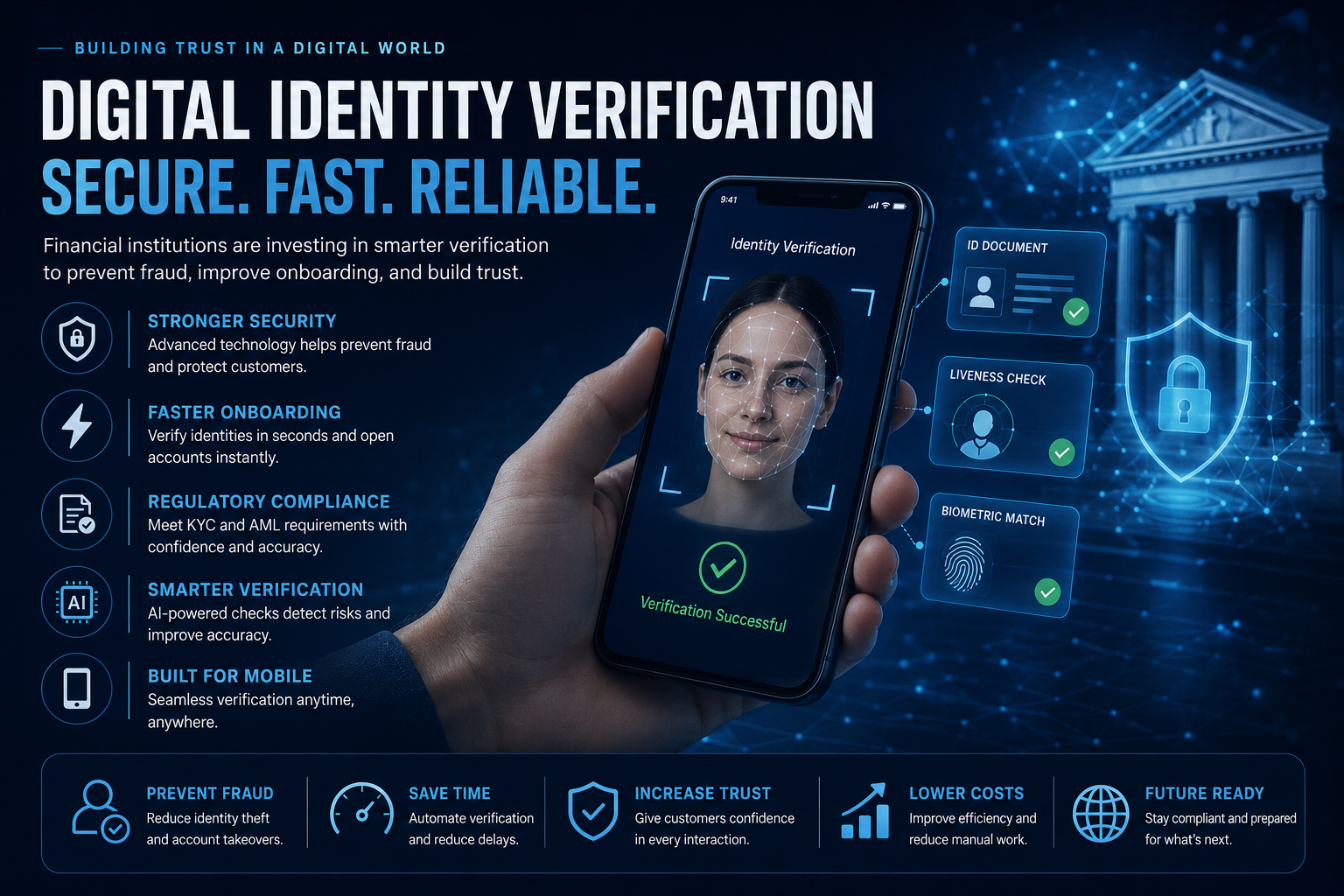
The financial industry is undergoing a major transformation as digital services continue replacing traditional in-person processes. Opening accounts, applying for loans, investing, and transferring money can now be completed entirely online. As financial interactions become increasingly digital, identity verification has become one of the industry’s biggest priorities. Banks and fintech companies are investing heavily in digital identity verification technologies to improve security while creating smoother customer experiences.
Fraud Prevention Is Becoming More Important
Financial fraud continues to evolve as cybercriminals adopt more sophisticated methods.
Organizations are facing challenges such as:
- Identity theft
- Account takeovers
- Synthetic identities
- Document fraud
- Credential theft
Traditional verification methods are often no longer sufficient to address these risks. Digital identity solutions provide additional layers of protection during customer onboarding and account access.
Faster Account Opening Improves Customer Experience
Consumers increasingly expect financial services to be available immediately. Lengthy verification processes can create frustration and lead potential customers to abandon applications.
Modern identity verification systems help reduce friction by allowing users to verify themselves through:
- Mobile devices
- Government-issued documents
- Facial recognition
- Biometric authentication
- Real-time verification checks
This creates a faster and more convenient onboarding experience.
Compliance Requirements Continue To Expand
Financial institutions must comply with regulations designed to prevent financial crime. Know Your Customer (KYC) and Anti-Money Laundering (AML) requirements remain essential parts of the global financial system. Digital verification technologies help organizations meet these obligations more efficiently while maintaining accurate records.
Artificial Intelligence Is Improving Accuracy
Many identity verification systems now incorporate AI-powered analysis.
These tools can assist with:
- Document validation
- Fraud detection
- Risk assessment
- Identity matching
- Behavioral analysis
As a result, verification processes are becoming both faster and more reliable.
Mobile Banking Is Accelerating Adoption
The growth of mobile banking has increased demand for remote verification solutions.
| Traditional Verification | Digital Verification |
|---|---|
| Branch visits required | Remote onboarding |
| Manual document review | Automated verification |
| Longer processing times | Near real-time approval |
| Limited availability | 24/7 accessibility |
| Higher operational costs | Greater efficiency |
Mobile-first consumers increasingly expect these capabilities as standard features.
Digital Identity Is Becoming A Competitive Advantage
Financial institutions are beginning to recognize that identity verification is not only a security requirement. A smooth onboarding experience can directly influence customer acquisition and retention. Companies that balance security with convenience often gain a competitive advantage in crowded markets.
Looking Ahead
Digital identity verification is becoming a foundational component of modern financial services. As fraud risks increase and customer expectations continue evolving, banks and fintech companies are expected to invest even more heavily in technologies that enable secure and efficient identity management.
In 2026, digital identity verification is no longer simply a compliance requirement—it is becoming a core part of the financial customer experience.
