
For years, tokenisation in banking has existed in an awkward space between promising technology and permanent experiment. Banks have built blockchain platforms, tested digital assets and demonstrated smart contracts, yet most customers still move money using familiar accounts, cards and bank transfers. A development in the UK in September 2026 suggests that one part of this technology is beginning to move beyond demonstrations.
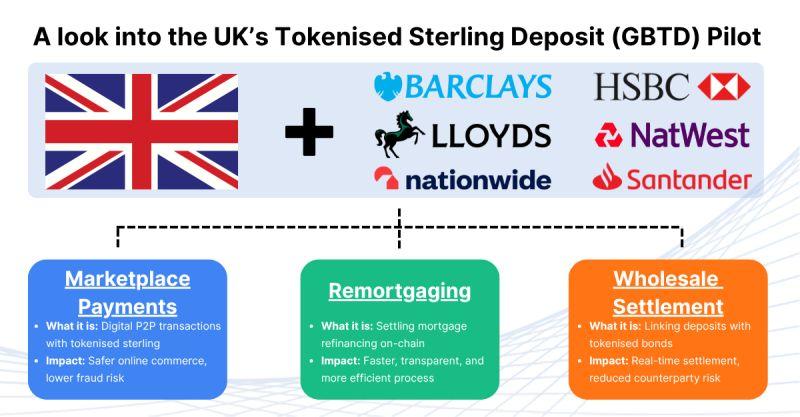
Major British banks have completed live customer transactions using tokenised sterling deposits. The tests included remortgage transactions and a person-to-person payment designed around an online marketplace purchase. Instead of creating a new cryptocurrency, the system represented ordinary commercial bank deposits digitally so they could move across programmable infrastructure.
That distinction matters. Tokenised deposits could bring some of the flexibility associated with blockchain-based money into conventional banking without asking customers to abandon bank deposits for an entirely different form of value.
What Is a Tokenised Bank Deposit?
A tokenised deposit is a digital representation of money held as a deposit at a commercial bank. Rather than existing only as an entry inside the bank’s conventional account infrastructure, the money can also be represented by a token on a digital ledger.
The easiest way to understand the idea is to compare it with other forms of digital money.
| Type of money | Issuer | Basic characteristic |
|---|---|---|
| Traditional bank deposit | Commercial bank | Money recorded in a normal bank account |
| Tokenised deposit | Commercial bank | Bank deposit represented on programmable digital infrastructure |
| Stablecoin | Private issuer | Digital token designed to maintain a stable value |
| CBDC | Central bank | Digital form of central bank money |
| Cryptocurrency | Decentralised network/project | Digital asset whose value can fluctuate significantly |
For customers, the important point is that tokenising a bank deposit does not necessarily mean converting their money into cryptocurrency. The UK’s Great British Tokenised Deposit initiative describes the technology as a digital representation of conventional commercial bank money. The aim is to preserve the characteristics of a bank deposit while adding capabilities such as programmability and more efficient settlement.
UK Banks Have Now Used the Technology for Live Transactions
The latest milestone is significant because participating institutions have moved beyond transferring experimental tokens inside isolated environments. The Great British Tokenised Deposit initiative involves Barclays, HSBC UK, Lloyds Banking Group, Monzo, Nationwide, NatWest and Santander. In September, participating banks completed the first set of live retail transactions using tokenised sterling deposits. Two use cases demonstrate why the technology could be useful.
The first involved remortgaging. Lloyds, NatWest and Barclays used tokenised deposits in transactions where funds could remain locked until the relevant property transaction had completed. Once the required condition was satisfied, the money could be released automatically.
Another test simulated an online marketplace purchase. Funds were reserved in the buyer’s account and designed to reach the seller only after the goods had been received. Neither example is particularly futuristic from the customer’s perspective. People already buy products online and refinance mortgages. What changes is the infrastructure coordinating when money moves.
Programmable Payments Are the Bigger Story
A conventional bank transfer generally follows an instruction: send a specified amount from one account to another. Programmable money can add conditions to that instruction.
Instead of simply saying:
Send £500 to the seller.
the transaction could effectively become:
Make £500 available, but release it only when an agreed condition has been satisfied. That opens several possibilities. Payment could be connected to delivery confirmation, completion of a property transaction or another verifiable event. The Bank of England has specifically highlighted conditional payments as one potential benefit of tokenised money.
The important change is that payment and the event triggering payment no longer have to be managed as completely separate processes.
A simplified transaction might look like this:
- The buyer authorises the transaction and the required funds are reserved.
- The payment conditions are recorded within the transaction process.
- The relevant external event takes place.
- The condition is verified.
- Funds are automatically released to the recipient.
Today, businesses often reproduce versions of this process through intermediaries, escrow arrangements and manual reconciliation. Programmability could make some workflows more direct.
Why Banks Are Interested in Tokenisation
Speed receives much of the attention whenever new payment infrastructure appears, but moving money faster is only one possible advantage. Modern domestic payment systems can already transfer funds quickly. The more interesting question is whether tokenised deposits can reduce the number of separate processes surrounding a financial transaction.
Banks are exploring several potential benefits:
- connecting payment with contractual conditions;
- reducing manual reconciliation between different systems;
- improving settlement of tokenised financial assets;
- supporting transactions outside conventional processing workflows;
- creating more efficient cross-bank digital infrastructure;
- reducing certain fraud risks through conditional release of funds.
The last point deserves some caution. Tokenisation does not make fraud disappear. Criminals can adapt to new payment methods, smart contracts can contain errors and digital infrastructure creates its own operational and cybersecurity risks. What conditional transactions can potentially change is when money becomes irrevocably available to another party.
Tokenised Deposits and Stablecoins Are Not the Same Thing
The growth of stablecoins has made this distinction increasingly important. Both stablecoins and tokenised deposits can use distributed ledger technology, and both can represent value digitally. Their legal and financial structures, however, can be quite different.
A tokenised bank deposit remains connected to a deposit liability at a regulated commercial bank. A stablecoin is generally issued by a separate private entity and relies on its own reserve and redemption structure.
This difference matters to regulators because bank deposits sit inside an established framework covering banking supervision, liquidity, capital and depositor protection. Stablecoins require their own regulatory arrangements.
The Bank of England has indicated that it expects multiple forms of digital money to coexist rather than assuming one technology will replace everything else. Its vision includes traditional deposits, tokenised deposits, regulated stablecoins and potentially a digital pound. That means the future of digital payments may be less about finding a single winner and more about making several forms of money interoperable.
The Hard Part Is Getting Different Banks to Work Together
Tokenisation itself is not new. Financial institutions have experimented with distributed ledgers for more than a decade. Interoperability has been a larger obstacle. If Bank A creates a tokenised deposit that works only inside Bank A’s proprietary infrastructure, its usefulness is limited. Real economies depend on money moving between customers, businesses and institutions that use different banks.
The recent UK transactions are therefore notable because they involved money moving across participating institutions rather than remaining inside one bank’s closed environment. That is also why governance matters as much as technology.
A functioning multi-bank network needs common rules covering issues such as:
| Area | Key question |
|---|---|
| Identity | Who is authorised to initiate the transaction? |
| Settlement | When is payment considered final? |
| Interoperability | Can different banks exchange tokenised deposits? |
| Liability | Who is responsible when something fails? |
| Privacy | What transaction data is visible and to whom? |
| Compliance | How are financial regulations applied? |
| Programmability | Which conditions can control the movement of money? |
UK Finance now plans to develop a rulebook and governance framework as the project moves toward production. That may prove just as important as the underlying ledger technology.
Mortgages Show Why Tokenisation Could Matter Outside Crypto Markets
The remortgage experiment is particularly useful because property transactions expose a problem that tokenisation is well suited to address. Buying or refinancing property involves several parties and multiple processes that must happen in the correct order. Funds may need to be available but should not necessarily be released until the legal transaction reaches the required stage. Traditional systems solve this through established banking and legal processes. They work, but coordination can require multiple organisations, messages and reconciliations.
Programmable deposits create the possibility of linking the availability and release of funds more closely to the completion event itself. This does not remove solicitors, lenders, compliance checks or property law. It potentially changes one part of the workflow: how money waits for and responds to a verified event. The same principle could eventually apply to other transactions where payment depends on delivery, documentation or completion.
Tokenised Money Is Moving Toward a Broader Financial System
The UK experiment is not happening in isolation. The Bank of England and Financial Conduct Authority have been developing a broader framework for tokenised financial markets. The Digital Securities Sandbox allows firms to experiment with tokenised assets under a regulated structure, while the UK’s upgraded real-time gross settlement infrastructure is being developed to interact more effectively with new digital ledgers.
The direction is becoming clearer: regulators are considering not only how assets such as bonds can become tokenised, but also what form of money should settle transactions involving those assets. A tokenised bond is considerably less useful if the cash side of the transaction still has to move through a completely disconnected process. Tokenised deposits could become one part of that settlement layer.
What Happens Next?
The September transactions do not mean ordinary bank accounts are about to move wholesale onto blockchain infrastructure. The technology still faces substantial questions around scale, privacy, resilience, interoperability, regulation and commercial demand.
The next stages should provide better evidence. The Great British Tokenised Deposit project plans to establish a company and develop the governance needed to move from pilots toward production. Participating banks also plan to issue digital bonds in the first quarter of 2027 that can be traded and settled using tokenised deposits.
That will push the concept into a more demanding environment. For fintech, the important development is therefore not that banks have discovered blockchain. They have been experimenting with it for years. The meaningful change is that tokenised commercial bank money is beginning to connect real institutions, real customer accounts and recognizable financial activities.
If those systems can scale, the customer may never need to think about tokens at all. A mortgage could complete more smoothly, an online marketplace payment could release automatically after delivery, or a financial asset could settle without several disconnected systems reconciling the transaction afterward. That may ultimately be the strongest sign that tokenised deposits have matured: not when customers start talking about them, but when the technology quietly disappears behind financial transactions that simply work better.
