
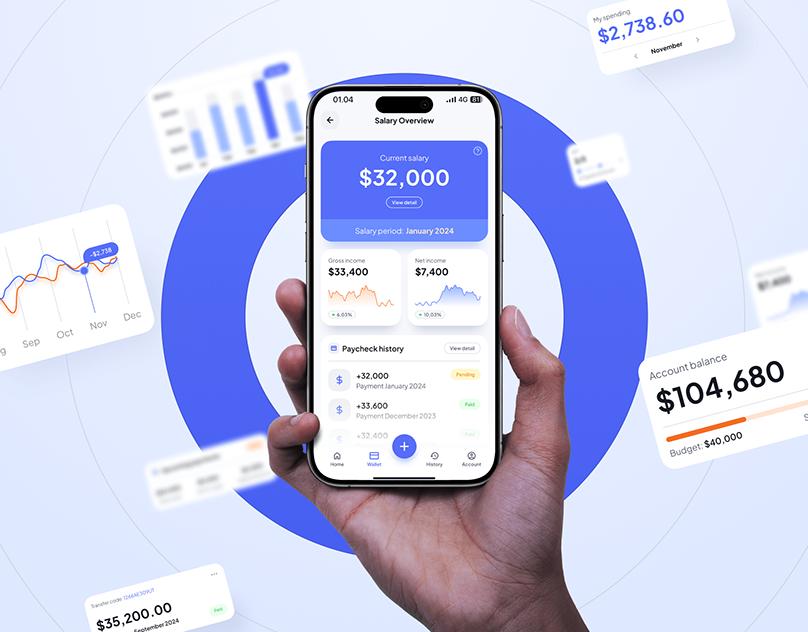
A transaction arriving in a bank account is easy for software to record but surprisingly difficult to understand. A €2,400 transfer could be a monthly salary, freelance income, money moved from another personal account or a one-off payment from selling something. Traditional banking interfaces rarely made much distinction between these situations. Money arrived, the balance increased and the transaction appeared somewhere in the account history.
Modern banking apps are starting to treat incoming money as something that deserves more context. Recognizing regular salary payments and distinguishing them from transfers or irregular income can improve several other features inside the app, from spending summaries to cash-flow projections. Instead of treating every incoming transaction as equivalent, the software can begin building a clearer picture of how money actually enters an account.
Income is harder to categorize than it looks
Recognizing a supermarket purchase is relatively straightforward when the transaction contains a familiar merchant name and merchant category. Income does not always arrive with such obvious clues. Employers can use different payroll descriptions, payment processors may sit between the employer and employee, and freelancers can receive money from dozens of unrelated clients.
Even regularity is not enough to identify a salary with certainty. A person might transfer a similar amount from a savings account each month, receive recurring support from a family member or collect rental payments on a predictable schedule. An app that labels every recurring incoming transfer as salary would quickly create inaccurate financial summaries.
Better recognition therefore relies on several signals rather than a single rule. Timing, transaction description, sender information, previous activity and amount patterns can all help the app determine what kind of payment has arrived. The objective is not necessarily to assign a perfect label instantly, but to reduce the amount of manual correction users have to do.
Salary recognition can make the account timeline clearer
Bank statements traditionally mix money coming in and money going out into one chronological list. That works for record keeping, but it does not immediately answer a basic financial question: where did this month’s usable money actually come from?
Identifying salary payments creates useful reference points in that timeline. Instead of scrolling through dozens of transactions looking for the beginning of a financial cycle, a user can see when regular income arrived and how spending developed afterward. For people paid monthly, the period between two salaries can sometimes be more meaningful than a calendar month running from the first to the thirty-first.
This allows banking apps to organize financial activity around the user’s actual money cycle. Rent, subscriptions, groceries and discretionary purchases can be understood in relation to income rather than treated as isolated transactions. The account history remains chronological, but another layer of context starts to emerge.
Not everyone has one predictable payday
The traditional model of income is simple: one employer sends one salary on roughly the same date every month. Many users still fit that pattern, but banking apps also need to handle much less predictable financial lives. Freelancers, contractors, gig workers and people with multiple jobs may receive several payments of different sizes throughout the month.
A useful income-recognition system cannot assume that irregular automatically means unusual. Five smaller client payments might collectively represent someone’s normal monthly earnings, while a single large transfer could be completely unrelated to work. Apps therefore need enough flexibility to recognize different income structures without forcing every user into a salaried-worker template.
This distinction also affects how the interface should present the information. Someone with one salary may benefit from a clear “salary received” marker, whereas a freelancer might find a monthly income total and source breakdown more useful. The underlying task is similar, but the presentation should reflect how the money actually arrives.
Internal transfers should not look like new income
Moving €1,000 from savings to a current account makes the current account balance larger, but it does not make the user €1,000 richer. Basic financial dashboards can easily create misleading numbers when they count such movements as income. The same issue appears when people regularly move money between several banks or personal accounts.
Recognizing internal transfers is therefore closely connected to recognizing genuine income. If an app can identify that money came from another account belonging to the same user, it can exclude that transaction from earnings calculations while still showing it in the transaction history. This produces much more useful monthly summaries.
Consider a user who receives €3,000 in salary and transfers €2,000 from savings during the same month. A simplistic system might report €5,000 of incoming money. A context-aware system can distinguish between the €3,000 earned and the €2,000 merely relocated, giving the user a much more accurate picture of their finances.
Better income data improves cash-flow views
Cash-flow tools depend heavily on understanding what money is expected to enter and leave an account. Recurring bills are only one side of that calculation. If the app cannot recognize the user’s normal income pattern, predictions about future balances become considerably less useful.
Suppose a current account contains €450 several days before payday. Looking only at the balance could make the financial position appear tight, particularly if several bills are approaching. If the app recognizes that a regular salary normally arrives before those payments are due, it has more context for showing the likely short-term position.
This does not mean future income should be treated as guaranteed. Salaries can change, clients can pay late and employment circumstances can change unexpectedly. A sensible interface can distinguish between confirmed money already received and expected income based on previous patterns instead of presenting both as equally certain.
| Incoming transaction | How an app might classify it |
|---|---|
| Regular employer payment | Salary |
| Repeated client transfer | Freelance or business income |
| Transfer from own savings account | Internal transfer |
| Tax refund | Refund or government payment |
| One-time marketplace payment | Other income |
| Reimbursement from a friend | Personal transfer |
| Investment distribution | Investment income |
The classifications themselves can vary between apps. What matters is avoiding the assumption that every positive transaction represents newly earned money.
Payday can become a useful financial anchor
Once a banking app understands when regular income usually arrives, it can organize other information around that date. A spending summary could show how much of the previous salary remains, while upcoming-payment tools can indicate which bills are likely to fall before the next expected payday.
This is often more intuitive than presenting everything through calendar months. Someone paid on the 25th may mentally manage money from one payday to the next, meaning a report covering September 1–30 cuts across two different income cycles. Organizing optional views around salary periods can better match how that person actually thinks about available money.
The same approach can help users understand changes in spending behavior. Instead of saying that restaurant spending increased compared with last month, an app might compare the current pay cycle with previous ones. The numbers are similar, but the context can make them easier to interpret.
Variable income needs ranges rather than fixed predictions
Predicting the next salary is relatively simple when the same amount arrives every month. Variable income requires more caution. A freelancer who received €3,800 last month, €2,500 the month before and €3,200 before that does not have a reliable €3,166 payment scheduled for next month simply because that is the average.
Banking apps can handle this uncertainty by presenting patterns rather than false precision. They might show typical monthly income ranges, the number of recurring income sources or how much has already been received during the current period. Historical averages can still be useful as long as the interface makes clear that they describe previous activity rather than guaranteed future payments.
This becomes particularly important when income information feeds into budgeting or financial guidance. Building recommendations around an optimistic income estimate can make the entire dashboard less trustworthy. Conservative assumptions and clearly labelled estimates are usually more useful than predictions that look exact but rest on uncertain data.
Users need an easy way to correct mistakes
Automated recognition will occasionally be wrong. An employer might change its payroll provider, a client payment might resemble a personal transfer or an unusual bonus could be mistaken for normal salary. If users cannot correct these classifications, one small error can distort several financial views at once.
A simple correction mechanism can solve much of the problem. The user might mark a transaction as salary, remove an internal transfer from income or indicate that a payment is a one-time event. The app can then use that correction to improve subsequent summaries and, where appropriate, recognize similar transactions in the future.
This is better than hiding classification entirely behind automation. Users do not need to understand the technical process, but they should be able to see why a transaction is affecting their income figures and change it when the result is obviously wrong.
Income sources can reveal financial concentration
Once incoming payments are classified reliably, the app can show something that a normal balance screen cannot: how dependent a user is on particular sources of money. For someone with a single employer, the answer may be obvious. For freelancers or small business owners, the picture can be considerably more interesting.
A contractor might discover that 65% of recent income came from one client despite working with several companies. Another user might see that a side project has gradually become a meaningful part of total earnings. These observations do not require sophisticated investment advice; they emerge simply from organizing existing transactions more intelligently.
The information can also help distinguish stable and irregular income. A regular salary, occasional freelance work and investment distributions have different patterns even though all three increase the account balance. Showing those differences makes the financial dashboard more informative without adding new financial products.
Salary changes can become visible sooner
Regular income creates a baseline, which means deviations from that baseline can be useful. If the normal salary amount changes, the app can highlight the difference instead of displaying the new payment as another ordinary transaction. The reason might be a pay rise, bonus, deduction, change in working hours or something else entirely.
The banking app does not need to guess why the amount changed. Simply showing that the latest salary differs from the usual range can prompt the user to look more closely. This follows a useful principle for financial software: identify the unusual pattern first and leave interpretation to the user when the data does not support a definite explanation.
Small changes can otherwise disappear inside a busy transaction list. Turning them into contextual information makes the account history more useful without overwhelming the user with constant alerts.
Recognition can improve savings automation
Automatic savings tools often rely on fixed schedules or user-defined amounts. Income recognition allows another approach: savings actions can be connected to money actually arriving rather than to an arbitrary calendar date.
For example, a user might choose to move a percentage of recognized salary into savings after each payday. Someone with variable income could use a different rule, perhaps transferring money only when incoming earnings exceed a certain threshold. Because the trigger is linked to recognized income, the automation can adapt more naturally to the user’s cash flow.
This type of feature still requires clear controls. Users should know which payments qualify, how much will move and what happens when income is unusually low. Recognition provides the context, but the user should remain in control of the actual financial action.
Privacy becomes more important as classification improves
Income recognition demonstrates a broader trade-off in digital banking. The more accurately an app understands transaction patterns, the more useful its financial tools can become. At the same time, income is sensitive financial information, and users may reasonably want to know how their data is being processed and which features depend on it.
Clear explanations matter more than technical jargon. If an app uses transaction history to identify recurring income, users should be able to understand what the feature does and how it affects summaries or predictions. Optional personalization controls can also help users decide how much analysis they want from their banking interface.
Good classification should make financial information easier to understand, not make users feel that hidden conclusions are being drawn from their accounts. Transparency becomes part of the product experience as banking apps move from displaying transactions toward interpreting them.
Income recognition connects several banking features
The value of recognizing income is not limited to putting a better label beside a transaction. Once the app knows which incoming payments represent earnings, that information can improve budgeting, cash-flow projections, savings automation, financial timelines and spending comparisons.
This creates a network effect inside the product. Improving one classification system makes several other features more accurate at the same time. A spending dashboard becomes more meaningful because internal transfers no longer inflate income, while a forecast becomes more useful because expected salary dates can be considered alongside upcoming bills.
The challenge is keeping those connections understandable. If changing the classification of one transaction alters several charts, the app should make that relationship reasonably clear. Otherwise, users may see numbers changing across the interface without knowing why.
Better banking apps are moving from recording money to explaining it
For a long time, digital banking improved mainly by making existing banking tasks faster. Customers could check balances without visiting a branch, send transfers from a phone and receive immediate transaction notifications. The next layer of improvement is less about speed and more about context.
Income recognition fits naturally into that shift. A banking app already knows that money entered the account; the useful question is what that money represents and how it relates to the rest of the user’s financial activity. Correctly identifying salary, freelance earnings, internal transfers and occasional payments can turn a basic transaction feed into a more accurate financial picture.
The best implementation is unlikely to be the one that assigns the most labels. It will be the one that recognizes common patterns reliably, admits uncertainty when necessary and lets users correct the system without friction. When that works, income stops being just another positive number in the transaction history and becomes useful context for understanding what the account can actually support.
